

Retirement Planning Checklist: 12 Months to Retirement (Free PDF)
Less than half of Americans over age 60 are on track to maintain the lifestyle they want in retirement. The decisions you make in the final years, and especially the last 12 months, can improve your timeline and confidence. This year is about confirming your financial readiness, finalizing important personal and family decisions, and preparing mentally for one of life’s biggest transitions.
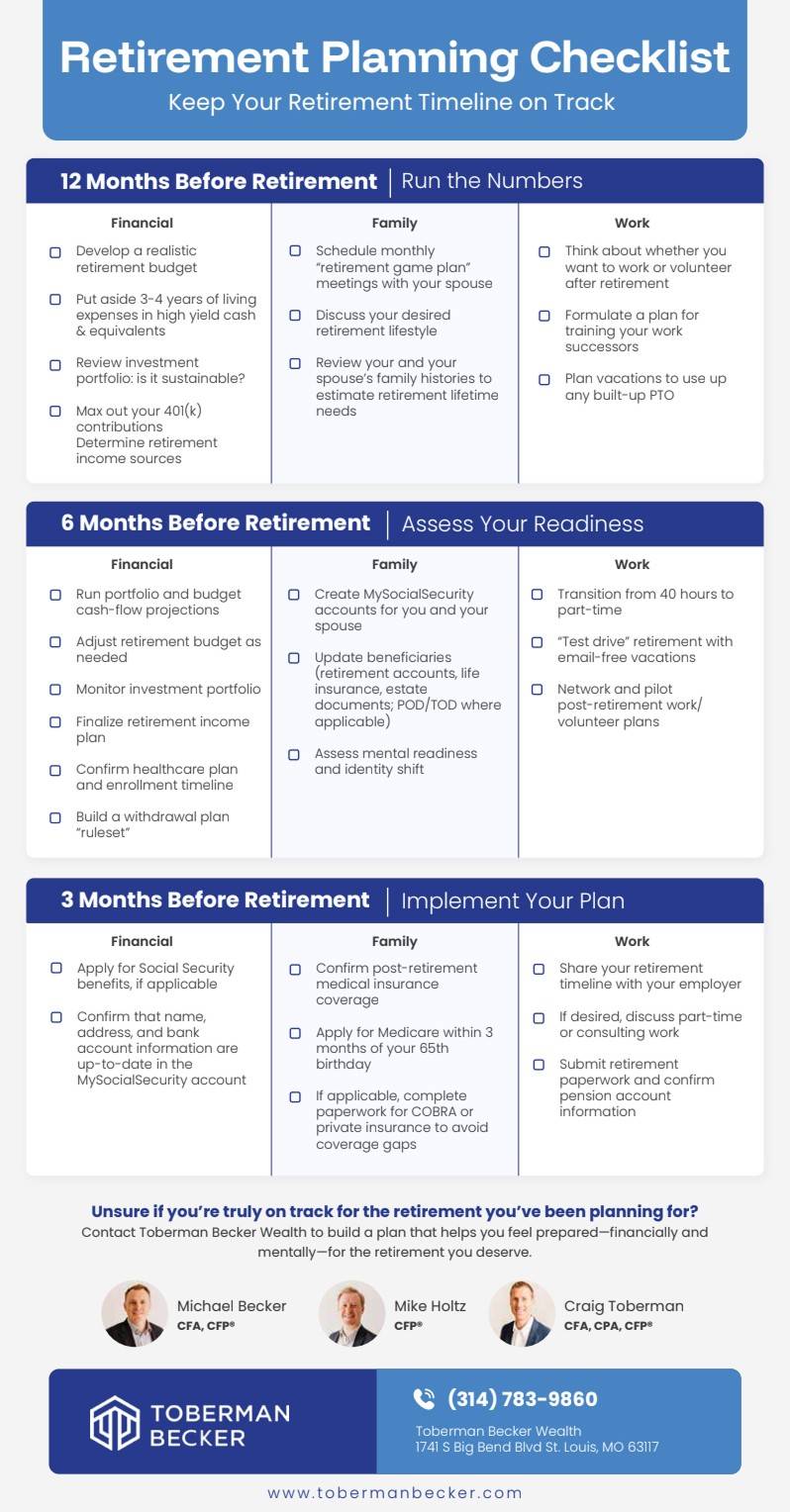
In this article, I share financial and personal to-dos we recommend to our clients for 12 months, 6 months, and 90 days before retirement, and I am including a free PDF to help keep you on track.
| The Year-Before-Retirement Roadmap | |
|---|---|
| Timeline | Focus |
| 12 Months to Retirement | Run the Numbers |
| 6 Months to Retirement | Assess Your Readiness |
| 90 Days to Retirement | Implement Your Plan |
12 Months to Retirement: Run the Numbers
Twelve months out from retirement is about asking critical financial questions to determine if retirement in a year is financially feasible—and taking steps to make it more likely.
Financial Decisions
-
Understand your budget now and in retirement
Review healthcare costs (especially if you retire before Medicare kicks in), monthly spending, debt, and “fun” spending. Then, ask yourself, will there be additional costs for new hobbies or activities you want to pursue in retirement? - Start teeing up 3-4 years of living expenses in cash Ideally, this cash staging is part of your long-term retirement planning, but now is the time to confirm that you have what you need. This is especially important if you’ll be on private healthcare insurance; you’ll want to be mindful of IRA distributions because income affects healthcare premiums. Additionally, having sufficient cash reserves helps you avoid being forced to sell your investments when the market is low (and thus locking in losses).
-
Adjust your investments for long-term stability
Historically, Bear markets have happened every 6 years or so, on average, so it’s not a matter of if, but when you’ll experience a market drawdown. Work with your advisor to design a diversified portfolio that you’re psychologically equipped to stick with in good times and bad. -
Max out your 401(k) contributions
Once you retire, you won’t be able to contribute to your 401(k), so determine an attainable goal (e.g., $30,000) and adjust your contribution schedule accordingly. We’ve had clients contribute 50% of their paychecks in the final months. -
Consider flipping to Roth contributions
If you’ll have a partial-income year, consider making Roth contributions instead of additional pre-tax contributions to take advantage of a lower income bracket. -
Work with your advisor to build a tax-efficient withdrawal strategy
Determine where your post-retirement money will come from. Will you pull from an IRA, a 401(k), a pension, or a combination of all three? When will you start claiming Social Security?
Family
-
Involve your spouse in planning
Many families have a designated “Family CFO,” but both spouses must be deeply involved and understand the game plan for it to work. -
Plan your retirement lifestyle
Do you want to travel? Move abroad or to another state? Work part-time or focus on leisure? Decide what you want to do, then determine whether you’ll be financially ready for that lifestyle.
Work
-
Determine post-retirement work (if any)
Start thinking about what you want to do after you retire. Will you join a board or a nonprofit? Start consulting? Work part-time? Volunteer? Include this in your planning. -
Make a plan for work successors
Retirement goes more smoothly when you feel confident you’ve properly trained the person who will fill your role. Start setting your successors up for success and give them opportunities to take on more. -
Use the vacation you’ve built up
We encourage our clients to use—not cash out—the PTO they’ve built up. This gives you a taste of retirement, and as an added bonus, helps you know the people you’re training can operate when you’re gone.
Are you prepared for one of your biggest life transitions?
6 Months to Retirement: Assess Your Readiness
Six months out, retirement really starts to feel real. It’s the time to begin mentally transitioning into retirement—and determine whether you’re still on board. We’ve seen many clients with rock-solid financial plans who are mentally unprepared for the sudden change in retirement and end up going back to work. Clarify this before you set your retirement in motion.Financial Decisions
-
Hammer out cash flow projections to keep your plan on track
Is your portfolio optimized? Is your spending under control? Make sure your plan is sustainable before you decide to retire.One way to measure your financial readiness is the Monte Carlo Online Simulation, which runs thousands of simulations to estimate the likelihood that a retirement investor’s financial plan will support them throughout their entirety of retirement. At Toberman Becker Wealth, we aim for 80%+ probability.
Family
-
Register for a MySocialSecurity account and lock in your benefit start date
Social Security benefits increase for each month you delay claiming Social Security beyond full retirement age. -
Update your beneficiary designations
They override your will, so review and update your designations on retirement accounts, estate documents, and life insurance.
Work
-
"Test drive" retirement
Start some hobbies. Take a two-week vacation. Consider transitioning out of the traditional 40-hour in-office workweek now to see what it’s like before you finalize your retirement decision. -
Start building relationships for post-retirement work
Whatever your post-retirement plans are, start networking now. If you want to do consulting or board work, try starting now to see if you like it while you still have an income.
Not sure whether your retirement savings are enough?
90 Days to Retirement: Implement Your Plan
In the final three-month stretch to retirement, shift from planning to implementation.Financial Decisions
-
Apply for Social Security benefits
If you plan to collect Social Security right when you retire, apply for Social Security benefits now. Otherwise, wait 3 months before you start claiming. Make sure your address, name, and bank account information are up to date to avoid payment delays.
Family
-
Confirm medical insurance for you and your spouse
Ensure your partner has a coverage gap. Regardless of when you start pulling Social Security, apply for Medicare within 3 months of your 65th birthday to avoid penalties that can permanently increase your premiums.
Work
-
Be open with your boss about your timeline
We often recommend clients start the conversation about three months before their planned retirement date—and definitely give more than the standard two weeks' notice. This helps you leave on good terms and maintain your reputation as a team player.We’ve even seen this transparency lead employers to be open to discussing part-time or consulting work.
-
Talk to your HR department
Submit your retirement paperwork early—especially if you’re retiring during a busy part of the year—to avoid delays and employer frustration.
Are You on Track for Your Dream Retirement?
The year leading up to retirement is often full of both excitement and trepidation, but a well-built plan helps you feel prepared—financially and mentally—for the retirement you’ve dreamed of.Retirement Planning FAQs
There are many ways to reduce your long-term tax burden, including cash staging, ramping up Roth contributions, not keeping too much in pretax buckets, and working with an advisor to form a tax-efficient withdrawal strategy.
It depends on a number of factors, including mortgage amount and your projected income. Your financial advisor can run a cost analysis to help you understand the benefits of paying it off vs. continuing payments through retirement.
One of the biggest mistakes we see is delaying retirement planning altogether and discovering their plan didn’t support their timeline. We recommend working with a financial advisor as early as possible to avoid surprises during this major transition. If you’re within 12–24 months of retirement, this is the ideal time to stress-test your plan with a CFP® professional.
Disclosure: Any mention of a particular security and related performance data is not a recommendation to buy or sell. The information provided on this website (including any information that may be accessed through this website) is not directed at any investor or category of investors and is provided solely as general information. Nothing on this website should be considered as personalized financial advice or a solicitation to buy or sell any securities.

Mike is a knowledgeable advisor at Toberman Becker Wealth in St. Louis. As a CERTIFIED FINANCIAL PLANNER® professional, he brings strong technical expertise and a client-first approach to helping families build and manage wealth at every stage of life. He prioritizes financial education, empowering clients to make informed decisions.
What sets Mike apart is his commitment to continuous growth. He is always expanding his knowledge to deliver better outcomes for the families he serves and values collaboration with colleagues to improve client experiences. At Toberman Becker Wealth, this commitment to learning and teamwork helps drive exceptional client experiences.
Outside of work, Mike enjoys anything related to golf—spending time with family on the course, competing with friends, and sharing his love for the sport at youth golf camps.