

Top 6 Ways to Maximize Social Security Benefits (2026)
Your Social Security strategy can either support or derail your ideal retirement lifestyle. In this article, I share 6 ways to maximize your benefits, including benefit timing and tax-smart income management, plus how to plan for potential Social Security changes.
1. Know Your Full Retirement Age and Estimated Benefit
Before you can make any decisions about Social Security, you need to know two numbers: your full retirement age and your estimated monthly benefit. These numbers are the foundation for every other strategy in this article.
Your full retirement age (FRA) is the age at which you’re entitled to 100% of the benefit you’ve earned. It depends on when you were born:
| Birth Year | Full Retirement Age | Reduction at 62 | Benefit at 70 (% of FRA) |
|---|---|---|---|
| 1943-1954 | 66 | 25% | 132% |
| 1955 | 66 and 2 months | 25.83% | 130.67% |
| 1956 | 66 and 4 months | 26.67% | 129.33% |
| 1957 | 66 and 6 months | 27.5% | 128% |
| 1958 | 66 and 8 months | 28.33% | 126.67% |
| 1959 | 66 and 10 months | 29.17% | 125.3% |
| 1960 or later | 67 | 30% | 124% |
Source: Social Security Administration
Your FRA matters because it’s the line between a reduced benefit and an increased one.
- You can claim as early as age 62, but doing so permanently lowers your monthly check by as much as roughly 30% if you claim the moment you’re eligible.
- Wait until you are FRA, and you receive your full benefit.
- Delay beyond FRA and you earn delayed retirement credits worth about 8% per year, up to age 70, after which there’s no additional gain from waiting.
To see your own numbers rather than general rules, create a free “my Social Security” account at SSA.gov. There you’ll find personalized benefit estimates at 62, at your FRA, and at 70, and you can confirm that your earnings record is accurate, which directly affects the benefit you’ll receive.
For early retirees, it’s especially important to understand that your estimates are based on your earnings to date and assume you continue to earn your current pay until the year you start your benefits.
Note: The figures above reflect current Social Security rules. Because these parameters can change, confirm the specifics for your situation at SSA.gov or with your advisor.
2. Work at Least 35 Years to Maximize Your Benefit
Your Social Security benefit is calculated based on your highest 35 years of earnings. If you report income for fewer than 35 years, zeros will be averaged into your calculation, drastically reducing your benefit amount.
- Track Your Earnings Record
Social Security statements are available online at SSA.gov. Review your record to verify the accuracy of your earnings history. - Consider a Part-Time Exit Strategy
If you’re eager to retire but have less than 35 years of earnings, even part-time income can boost your average and improve your benefit calculation by replacing zero-earning years.
3. Delay Your Social Security Claim to Maximize Monthly Benefits
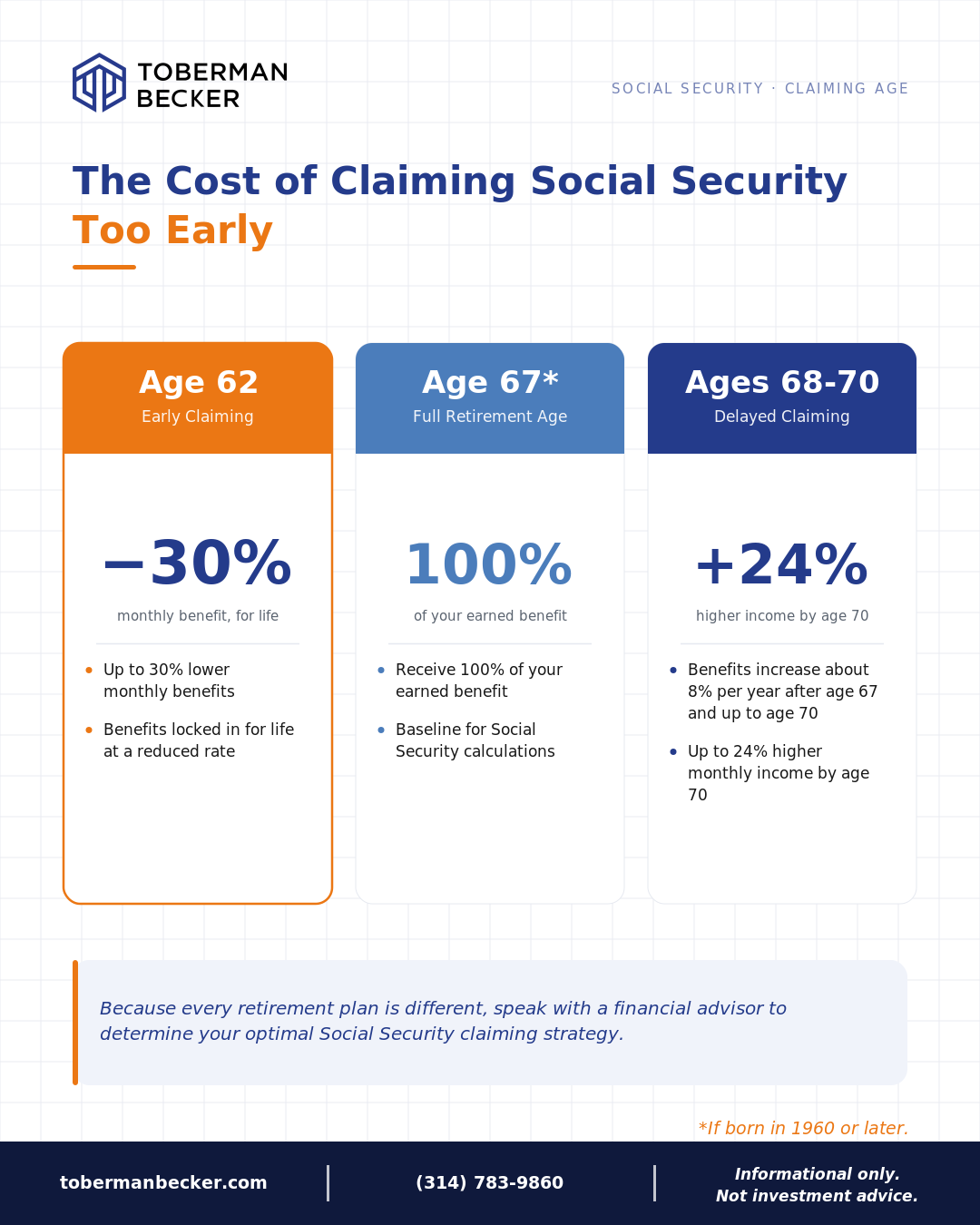
Retirees can start claiming benefits anytime between the ages of 62 and 70. Those who wait until 70 maximize their monthly check, receiving up to roughly 124% of their full benefit (for anyone with a full retirement age of 67).
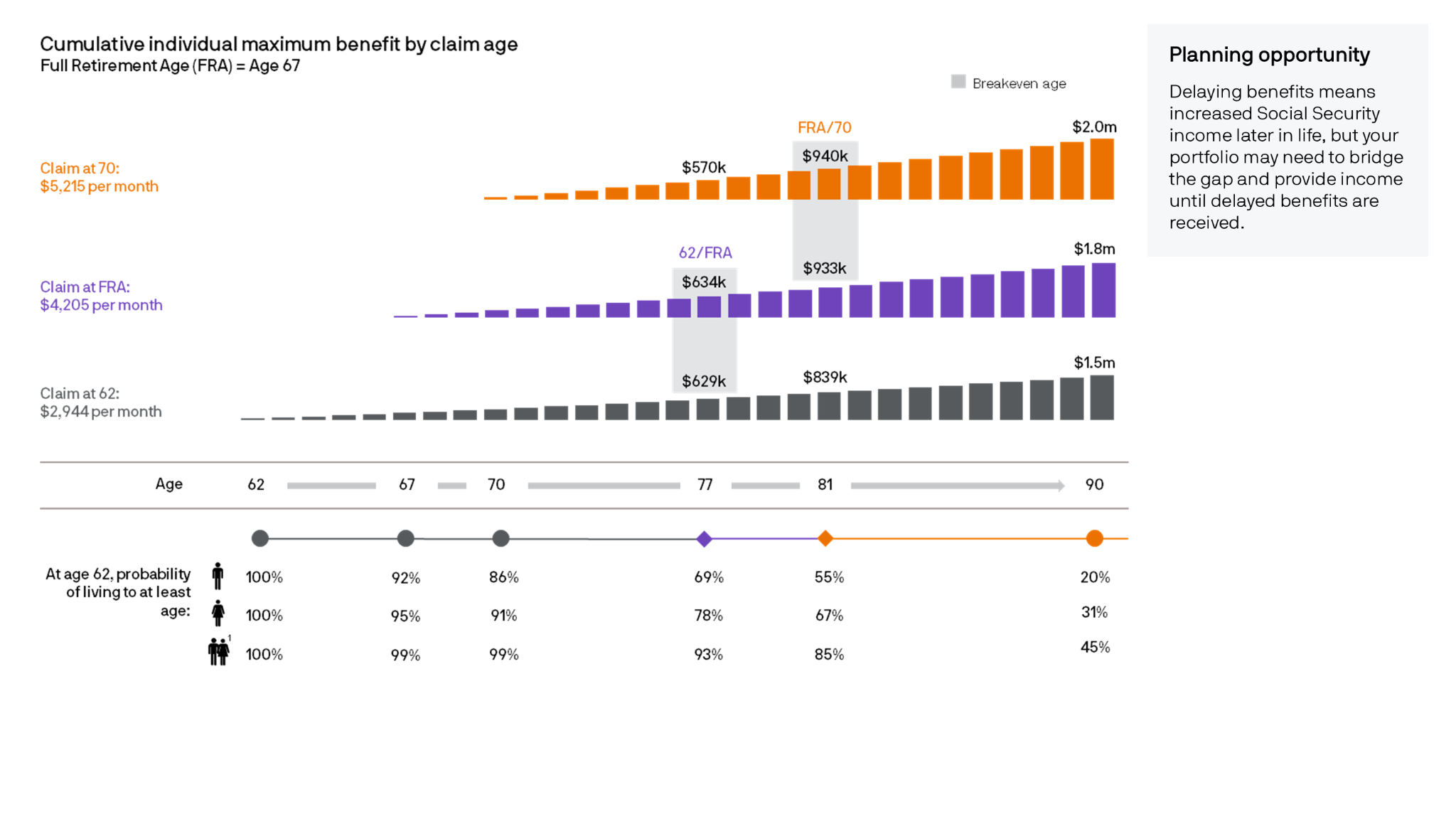
The cumulative maximum benefit for an individual varies by claim age. An individual who claims benefits at Full Retirement Age will not break even with the delayed option until age 80.
Source: 2026 JP Morgan Guide to Retirement
Here are three options to consider, using a $3,000 full benefit as an example:
- Early Retirement | Ages 62-66
- Benefit reduction: Up to 30% lower benefits
- Sample benefit: $2,100/month
- Full Retirement Age (FRA) | Age 67
- Full benefit
- Sample benefit: $3,000/month
- Delayed | Ages 68-70
- Benefit increase: about 8% per year after FRA, up to a total 24% increase by age 70
- Sample benefit: $3,720/month
Claiming benefits at age 70 provides the highest possible monthly benefit. While the break-even age compared with claiming at age 67 is typically in the early 80s, individuals who live beyond that point can benefit from greater cumulative lifetime income and increased financial security throughout retirement.
Use our Social Security Benefits Calculator, input your data, and receive a personalized estimate.
For most people, relying on other liquid assets until FRA is a great way to maximize benefits. However, unique circumstances, like health issues or concerns about Social Security’s future, might make claiming at 62 the right decision.
4. Coordinate Social Security Benefits With Your Spouse
Social Security offers spousal and survivor benefits that can significantly impact household income for married retirees. Strategically coordinating claiming plans with your spouse can help you meet immediate income needs while also maximizing the benefits of delaying collection.
- Spousal Benefits
If you are 62+ years old and your higher-earning spouse has started collecting their benefits, you may be eligible to receive up to 50% of their full retirement benefit. If your marriage lasted at least 10 years, you may still qualify for spousal benefits even if divorced. - Survivor Benefits
When a spouse passes away, the surviving spouse can often receive their benefits OR the deceased spouse’s, depending on which is higher.
5. Manage Retirement Income Levels to Avoid Tax & Medicare Implications
Retirees with higher income levels may be subject to federal income tax on Social Security benefits and to higher Medicare Part B & D premiums. Up to 50-85% of your benefits may be taxable if your provisional income exceeds $25,000 for single filers or $32,000 for joint filers, thresholds that have never been indexed for inflation, which is why a growing share of retirees owe tax on their benefits over time.
Depending on your situation, we often recommend the following strategies to manage retirement income levels:
- Execute a Roth Conversion
Convert traditional IRA funds to a Roth IRA before collecting Social Security benefits to reduce future taxable income. - Invest in a Treasury Bond Ladder
A diversified bond portfolio that uses a laddered approach with staggered maturity dates helps ensure that a retiree receives principal reimbursements on a set schedule, covering retirement expenses without unexpectedly crossing a higher income threshold. At Toberman Becker Wealth, we design bond ladders in 8-year increments to mitigate economic risk, often scheduling maturities so clients receive cash payouts every January.
6. Prepare for the Unknown Future of Social Security
Though recent projections suggest that funds may be depleted by 2032, our view is that the government will likely opt to increase taxes rather than face the litany of negative consequences that would arise if Social Security and Medicare were to lose funding.
Still, reliable retirement plans require analysis of all known risk factors, and potential changes to Social Security represent a legitimate risk for some portfolios.
Prepare by Stress Testing Social Security Benefits
Determine whether your portfolio could support your retirement lifestyle with a reduced Social Security benefit. Retirement modeling software gives a clear snapshot of your asset mix, demonstrating how much your budget depends on Social Security income.
Request a retirement model that forecasts EACH possible change to Social Security, including:
- Reduced benefits
- Increased tax rates
- Dissolution of benefits
- Reduced cost-of-living adjustments
- Reduced inflation adjustments
How Do Financial Advisors Help Develop a Social Security Strategy?
Maximizing your Social Security benefits requires thoughtful planning and a clear understanding of how the system works. While a basic benefits calculator can provide an estimate, a financial advisor uses expertise and advanced tools to account for the unique details of your retirement plan.
A comprehensive analysis by a financial advisor often includes:
- Cash flow projections (to track income and expenses)
- Portfolio return simulations (to estimate investment growth)
- Spousal benefit optimization
- Fixed income estimates
Toberman Becker Wealth combines these factors to create a customized strategy that helps you make confident, informed decisions about your financial future.
About Toberman Becker Wealth
Toberman Becker Wealth is a fee-only, independent fiduciary firm based in St. Louis. Whether starting to dream about retirement in your 50s or actively planning for retirement in your 60s in your 60s, we can help you formulate a resilient retirement plan.
We always operate in the best interests of our clients. Our top priority is helping you live comfortably now and in the future with a substantial savings strategy.
If you’re looking for an investment advisor to help you build a diversified retirement plan that ensures comfort and peace of mind, please book a meeting or give us a call.
Social Security Benefits FAQ
Social Security is a U.S. government retirement benefit funded by FICA (Federal Insurance Contributions Act) payroll deductions. About 15% of your income is contributed to provide future financial support during retirement. In traditional employment, you pay half; your employer covers the other half.
Your Social Security benefit is determined by the FICA taxes you paid throughout your career, with the calculation based on your 35 highest-earning years. If you worked fewer than 35 years, the remaining years are filled in as zeros, which can lower your average. The more you earn (up to the annual cap) and the longer you work, the higher your potential benefit.
For those born after 1960, the full retirement age (FRA) is 67, but you also have the option to start receiving benefits as early as 62 or as late as 70. The age at which you start collecting Social Security impacts your benefit amount. To encourage delaying, the government increases your monthly payment amount each year you delay benefits, up to age 70.
- Early Retirement (Ages 62-66): Up to 30% of the benefit is reduced
- Full Retirement Age (Age 67): Full benefit
- Delayed (Ages 68-70): About 8% per year after FRA, up to a total 24% increase by age 70
The ideal time to collect Social Security depends on your situation. These questions can help you decide what’s best for you and your family:
- Are you still working or planning to work beyond full retirement age?
- Do you have other income sources or assets to cover your expenses until you begin collecting?
- Do you have any serious health concerns that may affect your decision?
- What is your life expectancy, and will your savings last throughout retirement?
Craig Toberman is a Partner at Toberman Becker Wealth – a fee-only, fiduciary financial advisor based in St. Louis. He assists families and businesses with strategic financial planning and long-term wealth management. He has over a decade of experience in financial services and has crafted custom financial plans for hundreds of families and businesses.